More enjoyable trip to Hachimantai and Appi, Iwate Prefecture, Japan

Challenges at the Matsukawa Geothermal Power Plant

Assignment

Geothermal power plants require less land per gigawatt than coal, wind, or solar power plants. They also emit fewer greenhouse gases and consume less water than most conventional energy generation technologies over an average energy output lifespan. Furthermore, geothermal energy is renewable because the steam and water extracted from the ground can be reinjected into the earth to replenish the resources. Base load power is stable, producing electricity reliably 24 hours a day, 7 days a week, year-round, under all weather conditions.
According to data released by the Ministry of Economy, Trade and Industry (METI), Japan ranks third globally in geothermal resources, following the United States and Indonesia. With the technical expertise accumulated by workers at power plants like Matsukawa and manufacturers like Toshiba and Mitsubishi—both among the world's top suppliers of geothermal turbines—Japan possesses everything necessary to reduce its dependence on imported fossil fuels. So why is Japan's geothermal industry lagging behind?
One reason is that geothermal power plants take time to construct and have lower output than fossil fuel power plants. Geothermal power plants are typically located in remote areas, incurring high initial construction costs. Furthermore, expensive exploratory drilling to determine geothermal viability is primarily left to private developers. Since most of Japan's geothermal resources lie within national parks and protected areas, concerns about drilling impacting landscapes and the environment, coupled with high upfront costs and no guarantee of success, have effectively deterred private sector investment in the industry.

Impact of the March 2011 Tohoku Earthquake and Tsunami

That situation changed following the March 2011 Tohoku earthquake and tsunami, and the subsequent triple meltdown disaster at the Fukushima Daiichi Nuclear Power Plant. In July 2012, the national government enacted the Feed-in Tariff (FIT) policy, aiming to create a virtuous cycle of investment, innovation, and cost reduction to support renewable energy. This move worked in favor of geothermal energy, and changes began to emerge.

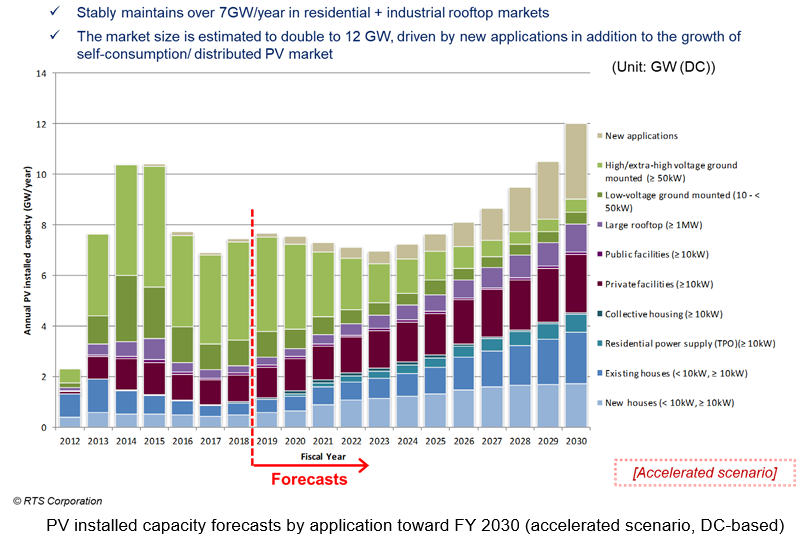
The Japanese government states that it will play a greater role in developing geothermal resources to achieve the goal of increasing its share from 16% of the total in fiscal year 2017 to 22% to 24% by fiscal year 2030. Starting in April 2020, the state-owned Japan Oil, Gas and Metals National Corporation (JOGMEC), under the supervision of the Ministry of Economy, Trade and Industry (METI), will conduct financially risky initial test drilling on behalf of potential developers. METI's Agency for Natural Resources and Energy (ANRE) estimates that by 2030, Japan's geothermal capacity will reach 1.4 million kilowatts, nearly triple the current 2019 level. In the Tohoku region, the Matsuo Hachimantai Geothermal Power Plant, a 7,499-kilowatt flash steam facility capable of meeting the hot water and electricity needs of an average 15,000 households, opened in January 2019. As of November 2019, three power plants are under development in Iwate Prefecture and one in Akita Prefecture. Tohoku Sustainable & Renewable Energy Co., Ltd., operator of the Matsukawa Power Plant, aims to double its total output from geothermal, hydroelectric, wind, and solar power facilities from 2017 levels to approximately 40,000 kilowatts by 2030.
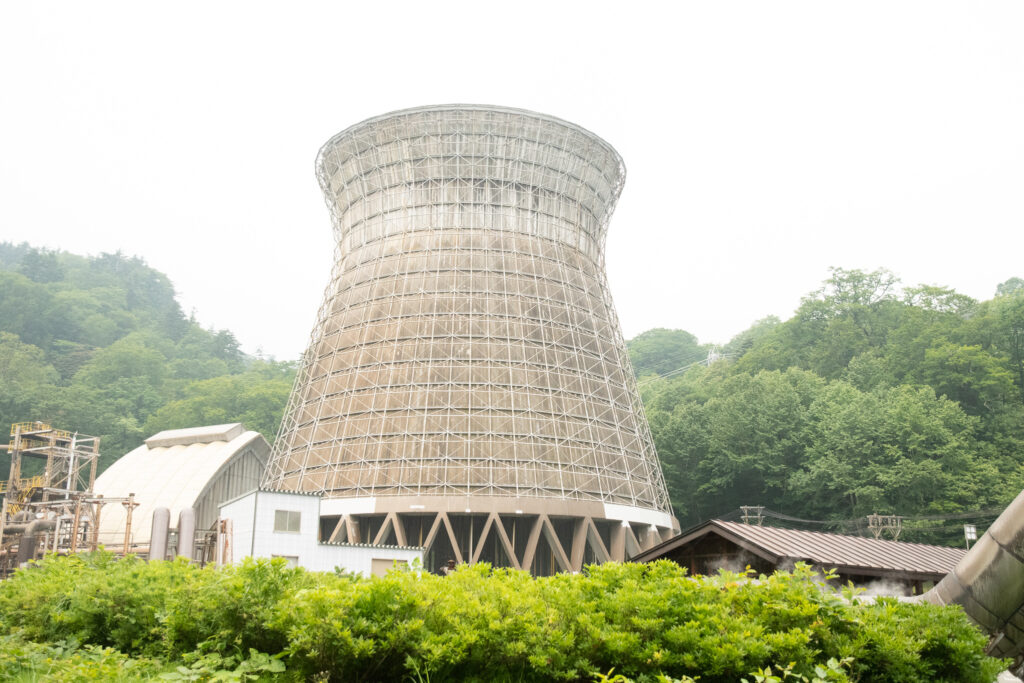
The Matsukawa Geothermal Power Plant
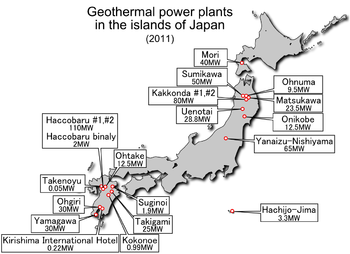
List of geothermal power plants currently in operation in Japan. Data source: TENPES (2018)

Matsukawa Geothermal Museum

The Matsukawa Geothermal Museum on the premises is open for visits from 9:00 a.m. to 4:00 p.m. on weekdays (except Tuesdays) from May to mid-November. No advance reservation is required. The museum's historical film (in Japanese) includes spectacular vintage footage of workers drilling to reach the first underground steam reservoir. The mechanical heritage on display—such as drill bits designed to cut through rock, drilling samples, and turbine rotor blades made from high-chromium heat-resistant 12CR steel—will be of particular interest to engineers and students. The original turbine, retired in 1993, is also exhibited here. Presentations by a member of the engineering staff can be arranged with advance reservation.
It takes about 2 hours by bus from Morioka Station to the Matsukawa Geothermal Power Plant. By car, it's 25 minutes from the Matsuo-Hachimantai exit on the Tohoku Expressway.